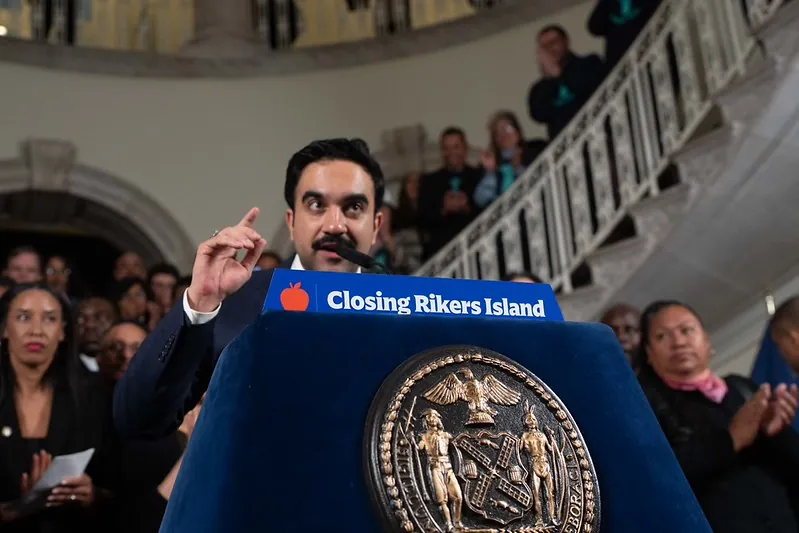
The City Council approved a ban on surveillance pricing at its stated meeting on Thursday, November 12, voting to bar companies from using the personal data of New Yorkers to set individualized prices. The bill, Introduction 891-A, is sponsored by Speaker Julie Menin, and the Council described it in its announcement as among the strongest surveillance pricing bans in the country.
Under the bill, as the Council summarized it, no business or service provider may engage in surveillance pricing. The bill's target is a price produced wholly or partly by an algorithm fed with a customer's own information, where the result is that one person is quoted more or less than another person for the identical purchase. The Council called the practice invisible to the people it charges, because a shopper has no way to see the price another shopper was offered.
"The City Council is putting consumers first by ending the deceptive and insidious practice of surveillance pricing," Menin said in the Council's announcement. "When corporations use algorithms and personal data to charge different people different prices for the same products, it's unethical and worsens our affordability crisis. We take consumer protection extremely seriously, and we will continue fighting to lower prices and stop predatory corporate tactics."
In the announcement, the Council pointed to investigations it said show the practice at work in ordinary shopping. One found that a major grocery delivery platform ran pricing experiments that produced individualized price differences as high as 23 percent. Another found that the price of a television at one retailer rose from $499.99 to $599.99 when the consumer pulled into the store's parking lot. The Council also cited a behavioral economist who worked for a major ride share company and said the application raises prices when a rider's phone battery is low.
The New York Post, reporting from City Hall on Thursday, put the vote at 44 to 5, said the bill has the support of Mayor Zohran Mamdani, and reported that larger companies would be hit at once with a $1,000 fine for violating the law, while small businesses would first have the chance to present an action plan to remedy a violation. The bill now goes to the mayor.
At the same meeting, the Council approved the three bill package for veterans that it had announced on Veterans Day. Introduction 1051-A, sponsored by Council Member Frank Morano, fully exempts the primary residence of a permanently and totally disabled veteran from city property tax and from special district charges, assessments and special ad valorem levies, where the veteran meets the other requirements of section 458-a of the state real property tax law. Introduction 488-A, sponsored by Council Member Inna Vernikov, requires the Department of Housing Preservation and Development to report each year on how many veterans and surviving spouses apply for city run Mitchell-Lama housing, and how many veterans are selected into it. Introduction 928-A, sponsored by Minority Leader David Carr, establishes a permanent LGBTQ+ liaison at the Department of Veterans' Services.
"New York State has already given local governments the authority to eliminate property taxes for veterans who are 100 percent disabled as a result of their military service, and it's about time New York City did its part," Morano said in the announcement. He put the reach of the exemption at approximately 4,500 veteran households, at a cost to the city of less than $5 million.
The stated meeting also approved Introduction 202-A, sponsored by Council Member Jennifer Gutiérrez, which sets deadlines for traffic safety work near schools: the Department of Transportation must make reasonable efforts to install improvements a traffic study has called for, including stop signs, speed reducers, traffic signals and school loading zones, within 120 days, or 180 days for traffic signals, subject to exceptions. And Introduction 178-A, sponsored by Council Member Harvey Epstein, requires five city agencies to give developers and owners centralized technical help with converting non-residential space into housing, including a designated liaison and a public website of educational materials.